


By Jacquie Cohen Roth, MS and Sunehera Hasib
Walk through a pine forest, peel an orange, or brush past a lavender bush, and you’re breathing in the same broad chemical family that gives cannabis its aroma. That family is terpenes and understanding them means understanding one of the oldest chemical languages plants use to survive.
Terpenes vs. Terpenoids: A Quick Distinction
The two words are used interchangeably, but they’re not identical. Isoprene is the plant’s basic building block: a five-carbon molecule that plants link together, end to end, to construct every terpene. Two isoprene units make a monoterpene; three make a slightly larger sesquiterpene. This chain-building happens inside the plant’s own cells, using the same basic process in nearly all plants, whether a pine tree, a lavender plant, or a cannabis plant.
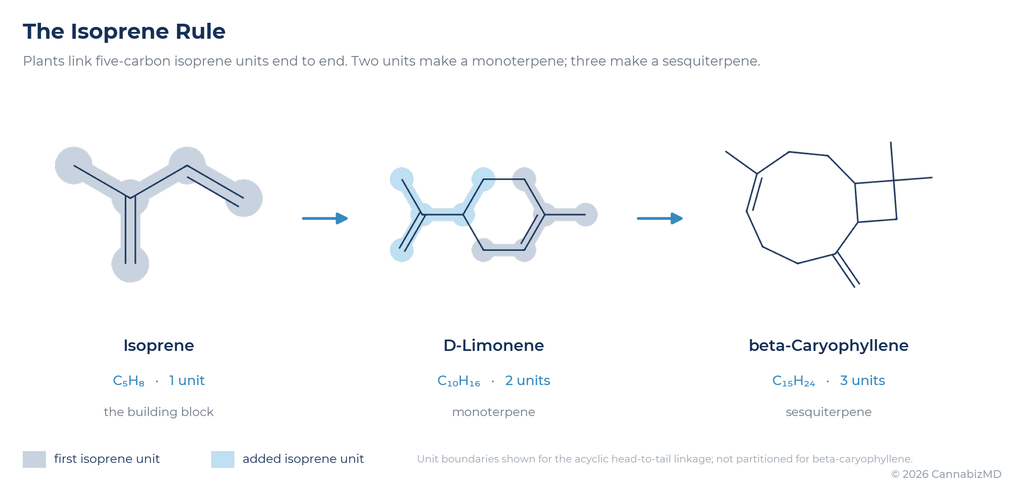
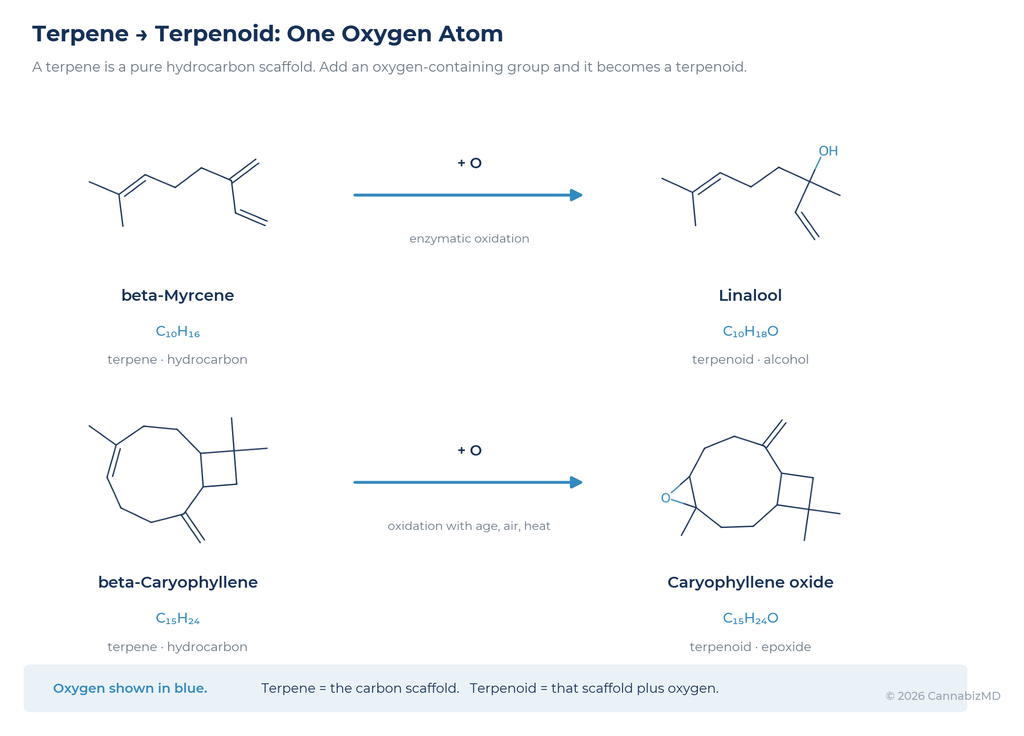
Terpenes are the product of that assembly alone: hydrocarbons built only from carbon and hydrogen, with nothing else attached (beta-myrcene, D-limonene). Terpenoids are terpenes that have gone through one more step, oxidation: an enzyme attaches an oxygen-containing group (an alcohol, aldehyde, or ketone) onto the terpene skeleton. That single added oxygen atom is the whole difference (linalool, alpha-bisabolol). Oxidation can happen in the plant itself or after the fact through exposure to air and heat, which is why aging cannabis picks up more oxygenated compounds over time.
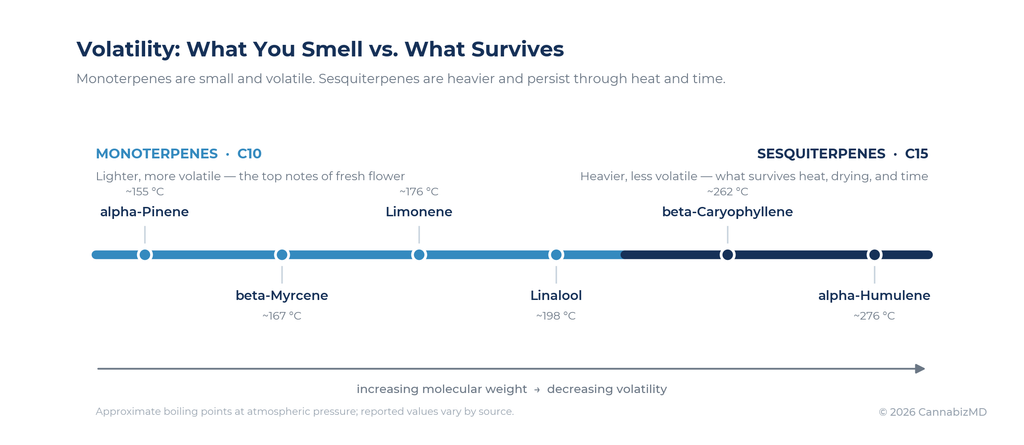
Cannabis consumers are arriving terpene-aware, largely through point-of-sale education, but that vocabulary obscures a real chemical distinction: “terpene” commonly refers to both terpenes and their oxygenated derivatives. Structurally, both are sorted by size: monoterpenes (limonene, pinene) are small and volatile, driving the smell of fresh flowers; sesquiterpenes (caryophyllene, humulene) are heavier, showing up more in background aroma and in what survives heat and time.
Why Plants Make Them at All
Terpenes aren’t just decoration. They’re part of how plants defend themselves, communicate, and survive, and that’s true whether you’re looking at cannabis, pine resin, hops, citrus peel, lavender, or thyme.
- Pest and herbivore defense. Many terpenes are bitter, irritating, or toxic to insects and grazing animals at concentration, discouraging them from returning to the same plant.
- Antimicrobial protection. Compounds such as alpha-pinene and D-limonene have documented antibacterial and antifungal activities, helping protect plant tissues from pathogens.
- Pollinator attraction. Floral terpenoids such as linalool and geraniol produce the sweet, floral notes that attract pollinators.
- Thermal and UV protection. Some terpenes help plants regulate temperature and buffer oxidative stress from sunlight.
- Chemical communication. Volatile terpenes can signal distress to neighboring plants or attract the natural predators of the insects attacking them.
Because this plant arsenal is so evolutionary, it’s conserved across unrelated plant families. Alpha-pinene, for instance, is among the most widely distributed terpenes in nature, found in the conifer resin of pine, fir, and spruce as readily as in cannabis. That shared chemistry is exactly why cannabis smells simultaneously “citrusy,” “piney,” or “floral,” depending on which of these ancient plant compounds happen to dominate a given chemovar (the more precise term for what’s commonly called a “strain”).
Terpenoids in the Cannabis Plant: Applications Beyond Aroma
Because terpenoids carry that extra oxygen atom, they tend to interact with the body more specifically than plain terpenes do. Cannabis produces dozens of them, and several have real applications beyond scent:
- Brain and nervous system research. Borneol is unusual because it helps other compounds cross the blood-brain barrier, the protective filter that normally keeps most substances out of the brain. That makes it useful as a delivery aid for other drugs, on top of its own pain-relieving and anti-inflammatory effects. Linalool, cannabis’s main floral terpenoid, has calming and anti-seizure properties.
- Skin care. Alpha-bisabolol, the main active compound in German chamomile oil, is a long-used skin-care ingredient for wound healing and calming irritation. It also helps other topical ingredients absorb better into skin.
- Antifungal use. Caryophyllene oxide, which forms when beta-caryophyllene ages and oxidizes, has shown antifungal effects in clinical use for nail fungus, comparable to standard antifungal drugs.
- Respiratory support. Eucalyptol loosens mucus and reduces inflammation, and it’s an approved ingredient in licensed respiratory medicines in Europe.
- Cancer research (early-stage, not approved in the U.S.). Beta-elemene has the most clinical history of any compound in this section — though note it is a sesquiterpene hydrocarbon (C15H24), not a terpenoid. Elemene injection and oral emulsion, formulations with beta-elemene as the principal active constituent extracted from the rhizome of Curcuma wenyujin, have been approved anticancer drugs in China since 1994 (elemene injection H10960114; oral emulsion H20010338). Two caveats matter: the source plant is a traditional Chinese medicine known as Ezhu or zedoary — not cannabis, and not turmeric, which is the separate species Curcuma longa — and the compound is delivered by injection or oral emulsion at therapeutic doses, not at the trace concentrations found in cannabis flower. Bisabolol and guaiol have shown cancer-cell-killing activity in lab studies, but only in early, preclinical research.
What Drives a Cannabis Plant’s Terpene Fingerprint
A cannabis plant’s terpene profile is a mix of genetics and environment. Terpene synthase genes — which code for the enzymes that assemble each terpene molecule — set the underlying potential, but cultivation conditions, light, harvest timing, drying, and curing all shift the final expression. That’s why two batches of the same-named cultivar can smell and test noticeably differently. Terpene content is genetically influenced, not fixed, and lot-specific lab testing (a Certificate of Analysis, or COA) is the only way to know what’s actually in a given batch.
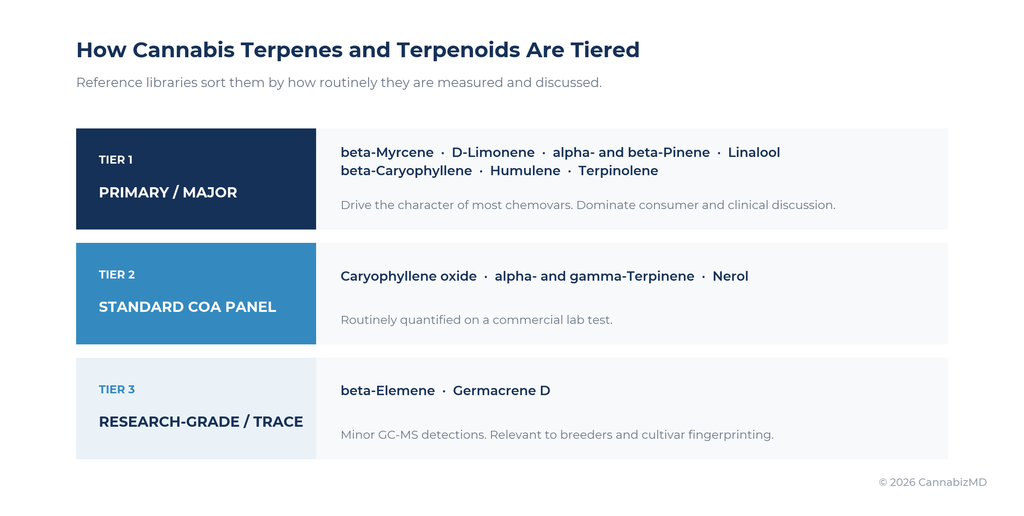
Reference libraries typically organize cannabis terpenes and terpenoids into three practical tiers:
- Primary / major constituents: terpenes such as beta-myrcene, D-limonene, alpha- and beta-pinene, linalool, beta-caryophyllene, humulene, and terpinolene, which drive the character of most chemovars and dominate consumer and clinical discussion.
- Standard COA panel analytes: compounds routinely quantified on a commercial lab test, such as caryophyllene oxide, alpha- and gamma-terpinene, and geraniol’s isomer nerol.
- Research-grade, trace constituents: minor GC-MS detections like beta-elemene and germacrene D, more relevant to breeders and cultivar fingerprinting than to everyday product decisions. Beta-elemene is a useful illustration of where these tier boundaries sit: trace in cannabis, but the same molecule sourced from Curcuma wenyujin carries decades of clinical history.
Dr. Ethan Russo and the Entourage Effect: Cannabis Science’s Landmark Framework
Do terpenes actually change how cannabinoids behave? The honest answer is “partially” — and it depends heavily on which terpene, which model, and how it is administered.
The entourage effect, the idea that cannabis terpenes and cannabinoids work better together than any single compound in isolation, is not a marketing phrase. It is a scientific framework authored by Dr. Ethan B. Russo, a neurologist and one of the most influential cannabis researchers of the last two decades. His 2011 paper in the British Journal of Pharmacology, “Taming THC: Potential Cannabis Synergy and Phytocannabinoid-Terpenoid Entourage Effects,” is the landmark reference nearly every subsequent terpene-cannabinoid study cites, including every primary terpene entry in this article’s reference library. Dr. Russo’s core argument was that cannabis’s therapeutic and sensory effects can’t be fully explained by THC or CBD alone: the plant’s terpenes and terpenoids modulate cannabinoid pharmacology, shifting effects like sedation, anxiety, pain relief, and even THC’s psychoactive intensity depending on which compounds accompany it and in what ratio.
Our findings suggest that these Cannabis terpenes are multifunctional
— LaVigne et al. (2021)
cannabimimetic ligands.
For years, Dr. Russo’s framework ran ahead of direct experimental proof. It was a compelling, well-reasoned synthesis of existing pharmacology rather than a set of new head-to-head experiments. That has changed with a run of newer studies from Dr. John Streicher’s pharmacology lab at the University of Arizona, which have begun testing the entourage hypothesis directly:
- LaVigne, Hecksel, Keresztes, and Streicher (2021), published in Scientific Reports, found that several cannabis terpenes and terpenoids (alpha-humulene and beta-pinene; geraniol and linalool) produced classic cannabinoid-like behavioral effects in mice on their own and selectively enhanced the effect of a CB1 receptor agonist when combined, providing early mechanistic support for synergy between terpenes and cannabinoids.
- Schwarz, Keresztes, Bui, and colleagues (2024), published in PAIN, went further, showing that five terpenes and terpenoids (alpha-humulene, beta-caryophyllene, and beta-pinene; geraniol and linalool) reduced pain in a mouse model of chemotherapy-induced nerve pain, with effects near the peak achieved by morphine, no signs of addictive reward, and an additive effect when combined with morphine. Follow-up work from the same lab — Seekins et al. (2025) in Pharmacological Reports and Schwarz et al. (2025) in Neuroscience Letters — has since extended similar findings to models of post-surgical pain and fibromyalgia, and to whole terpene blends rather than single isolated compounds, which is closer to how cannabis is actually consumed.
Two details from that research matter more than the headline.
The mechanism doesn’t run through the usual cannabinoid receptors. The pain-relief effect was linked to activation of the adenosine A2A receptor, a target distinct from CB1 or CB2. Adenosine receptors are a separate signaling system the body uses to regulate pain, inflammation, and sleep-wake balance — the same receptor family caffeine blocks to keep you awake. Finding that cannabis terpenes activate this pathway means they may be relieving pain through a mechanism that has nothing to do with the cannabinoid receptor system most people associate with cannabis. That is notable because beta-caryophyllene is the one terpene with a well-established, direct cannabinoid-receptor mechanism: Gertsch and colleagues (2008), publishing in PNAS, identified it as a selective CB2 receptor agonist, sometimes described as a “dietary cannabinoid” in its own right. In other words, terpenes may be doing real pharmacological work, but not always through the pathway people assume.
The route of administration changed everything. In the Schwarz et al. (2024) pain study, the effects were significantly reduced or disappeared entirely when the terpenes were administered orally or by inhalation, rather than via the injection route used to establish the effect. That is a meaningful caveat for a product category built almost entirely on inhalation and oral consumption, and a reminder that a result from a mouse injection doesn’t automatically translate to a vape or an edible.
Fifteen years on, Dr. Russo’s framework has held up well: the newer receptor-level and behavioral work isn’t replacing his synthesis so much as filling in the mechanistic detail he predicted would eventually be found.
Evidence Tiers Matter
Claims about cannabis terpenes circulating online routinely blend three very different kinds of evidence: in vitro (petri dish / cell) findings, preclinical (rodent) findings, and human clinical findings. Most of the terpene-cannabinoid pharmacology described above remains preclinical and, while real and peer-reviewed, is not yet equivalent to a controlled human trial. Being specific about which tier a claim belongs to is the difference between an educational summary and an overstated therapeutic claim.
A Few Regulatory and Safety Nuances Worth Knowing
- “GRAS” is about eating, not inhaling. Generally Recognized As Safe (GRAS) and FEMA GRAS designations apply to food-use ingestion levels. They say nothing about inhalation safety, which is the dominant route for cannabis. Delta-3-carene, for example, is GRAS as a food flavoring yet documented as a respiratory irritant in occupational studies.
- Myrcene has a real regulatory history. The FDA revoked the authorization for synthetic myrcene flavoring in October 2018 under the Delaney Clause, following findings of rodent carcinogenicity in a National Toxicology Program study. Naturally occurring myrcene remains permitted as a food flavoring, and myrcene is also on California’s Proposition 65 list. This nuance — synthetic vs. natural, and food use vs. inhalation — gets flattened in much consumer content.
- Some terpenes on a cannabis COA shouldn’t be there. Compounds like camphor, menthol, and pulegone aren’t meaningfully produced by the cannabis plant itself. Their appearance at notable levels on a flower test is more likely a sign of added terpenes, cross-contamination, or a misidentified peak than a genuine feature of that chemovar.
The Bigger Picture
Cannabis terpenes keep inviting comparison to other aromatic plants because the chemistry is genuinely shared. What differs are dose, matrix, and route, and those differences are where most of the overclaiming lies. The current generation of research is finally addressing them directly: cannabis-derived terpenes tested in blends, against specific receptor targets, at physiologically plausible concentrations. That is a substantially higher bar than the entourage claims circulating a decade ago. For anyone advising patients or writing about this plant professionally, it also means that the primary literature and the plain-language summary have begun to diverge, and that the details increasingly exist only in the former.
About the Authors
Jacquie Cohen Roth, MS, is founder/CEO of CannabizMD and sister nonprofit The Tea Pad Foundation
Sunehera Hasib is a CannabizMD intern intentional on using data and public health research to better understand the therapeutic potential of cannabis, its relationship with mental health and substance use, and how evidence can help us develop more informed and compassionate approaches to holistic health and care.
References
LaVigne JE, Hecksel R, Keresztes A, Streicher JM. Cannabis sativa terpenes are cannabimimetic and selectively enhance cannabinoid activity. Sci Rep. 2021;11:8232. doi:10.1038/s41598-021-87740-8
Schwarz AM, Keresztes A, Bui T, et al. Terpenes from Cannabis sativa induce antinociception in a mouse model of chronic neuropathic pain via activation of adenosine A2A receptors. PAIN. 2024;165(11):e145-e161. doi:10.1097/j.pain.0000000000003265
Seekins CA, Welborn AM, Schwarz AM, Streicher JM. Select terpenes from Cannabis sativa are antinociceptive in mouse models of post-operative pain and fibromyalgia via adenosine A2a receptors. Pharmacol Rep. 2024. doi:10.1007/s43440-024-00687-1
Schwarz AM, Seekins CA, El-Sissi O, Streicher JM. Terpene blends from Cannabis sativa are cannabimimetic and antinociceptive in a mouse chronic neuropathic pain model via activation of adenosine A2a receptors. Neurosci Lett. 2025. doi:10.1016/j.neulet.2025.138205
Gertsch J, Leonti M, Raduner S, et al. Beta-caryophyllene is a dietary cannabinoid. Proc Natl Acad Sci USA. 2008;105(26):9099-9104. doi:10.1073/pnas.0803601105
Russo EB. Taming THC: potential cannabis synergy and phytocannabinoid-terpenoid entourage effects. Br J Pharmacol. 2011;163(7):1344-1364. doi:10.1111/j.1476-5381.2011.01238.x
Booth JK, Bohlmann J. Terpenes in Cannabis sativa — from plant genome to humans. Plant Sci. 2019;284:67-72. doi:10.1016/j.plantsci.2019.03.022
Al-Khazaleh AK, Zhou X, Bhuyan DJ, Münch GW, Al-Dalabeeh EA, Jaye K, Chang D. The neurotherapeutic arsenal in Cannabis sativa: insights into anti-neuroinflammatory and neuroprotective activity and potential entourage effects. Molecules. 2024;29(2):410. doi:10.3390/molecules29020410
Cox-Georgian D, Ramadoss N, Dona C, Basu C. Therapeutic and medicinal uses of terpenes. In: Medicinal Plants. 2019 Nov 12:333-59. doi:10.1007/978-3-030-31269-5_15. PMCID: PMC7120914
NTP Technical Report 557: Toxicology and Carcinogenesis Studies of beta-Myrcene. National Toxicology Program, National Institute of Environmental Health Sciences. 2010.
Revocation of the synthetic myrcene flavoring listing, 21 CFR 172.515. 83 FR 50490 (Oct 9, 2018).
PubChem. National Center for Biotechnology Information, National Library of Medicine, NIH. Compound records for cited terpenes. https://pubchem.ncbi.nlm.nih.gov/
NIST Chemistry WebBook (Standard Reference Database 69). National Institute of Standards and Technology, U.S. Department of Commerce. https://webbook.nist.gov/chemistry/